Introduction to Telecommunication Studies
Spring 2014
Team Programming Project
* Your challenge is to develop a cross-platform program for a broadcast environment. After you have completed your project, you will FIRST pitch your program to a committee of investment bankers at a formal Pitch Presentation on April 29/May 1. See these links:
Studio Pitch Meetings: An Amusing Look at Pitching Your Script
Notice that these two pieces focus on how a writer can pitch an idea or a script to a producer (or the producer's intern). Your pitch will tease us with a well thought business, including the show, the web, the sponsor list, and so on.
Then, you will SECOND submit your project, suitably bound, at an announced time during the final examination meeting.
It may be for radio or television (over-air, web or cable).
It must have a web site.
It should have the potential for making money (or for using underwriter money for socially desirable "goods.")
You should use a standard length (normally 30 or 60 minutes - including commercials).
It should have "legs" - either as a regularly-scheduled program or as a product that can be used several different times in other ways.
Start planning by identifying your audience. What might be an audience which you could sell to advertisers? If you decide to make a "noncommercial" show, what audience might you attract which underwriters might want to reach? Once you've answered that question, you should ask, "Now how can we make a program which will catch them?"
You may zero in on demographics/psychographics in a reasonable way, but you may not program for the 18-24 demographic category (see Syllabus).
* Your team will share a number of duties. They are summarized in this table:
|
Duty |
Description |
| Executive Producer | Overall coordinator of the project. Divides up the tasks, assigns them to team members, and keeps everyone's efforts focused |
| Marketing function | Marketing deals with building a relationship between the producer and the audiences, especially viewers and sponsors. So this means marketing people research the pool of potential clients (advertisers !!); develop a sales strategy; and develop sales presentation. Develops an audience |
| Research function | Researches potential audience and potential sponsors |
| Program Producer | Creative responsibility for making the show |
| Writer | Writes the script for the show |
| Production function | This team comprises communication artists who can perform and capture/edit the program to final form such as DVD. |
| Creative Services function | Develops the promotional campaign |
| Web Developer | Designs and builds out the web experience. |
Figure out where your target audience may be found (both media-wise and otherwise). Create a program that would offer value to them -- that they might want to watch or listen to. Develop a strategy for luring them away from their current media/lifestyle activities. (Remember, audiences are already doing something at the time of your program's airing!) Write a script/treatment for the program's pilot episode. Include a budget, or at least an estimate of program costs. Simple studio talk shows for noncommercial or "cable access" run about $400 each. "Kicked up" noncommercial shows made locally run about $8-10k. Anything for regional or national distribution must be much better, as reflected here:
"The concept that I am working on is in-studio with a massive scenic design set and we're shooting 3-4 30 minute episodes per day HD with 5 cameras in a live switch situation. We also have an animated 30 sec opening sequence and 3-4 45 sec animated vignettes within the program. My total budget for 13 episodes with contingencies is just over $50k per episode."
Prime time dramatic shows can be budgeted up to $4 million per episode, largely due to A-list talent.
Top-level sports and "special" programs require the rental of a "day" studio or a remote production truck. The best available is AMV's "Titan" at $22,500 per day in equipment costs (not labor), including up to eight cameras and up to eight VTRs. Additional cameras for Titan are $1500 per camera per day. Additional VTRs for Titan are $1250 per machine per day. A typical one-week rental of "Titan" costs about $100,000-$150,000 for equipment, plus $21,000 for Truck Support Labor. Production and engineering crew are extra.
An uplink truck would be $4,000 for High Definition, or $2,500 for Standard Definition (NTSC), including labor (driver/operator) and 2 road days at mileage only ($3.00 per mile). Satellite time is extra.
Smaller trucks, such as AMV's Celebrity, Resolution or Crossroads, are $20,000 per day in equipment costs (not labor) for up to eight cameras and eight VTRs. Additional cameras are $1500 each per day. Additional VTRs are $1000 each per day.
Truck Support Labor is typically four men at $750 per man-day each.
Then, to rent an even smaller analog truck (that's a truck with analog electronics), you'd be talking the "Straight" at $10,000 per day for up to eight cameras and eight VTRs -- but not labor. For Straight, additional cameras are $1500 per day, each, and additional VTRs are $500 per day, each.Finally, AMV's "Stubby" is $5,000 per day in equipment costs (not labor) up to five cameras and five VTRs. Truck Support Labor is typically two men at $750 per man-day each.
Be careful: you don't have access to a universe of talent, facilities and money. No, you can't hire Alicia Keys, Lady Gaga, Adele, Leona Lewis, Steve Harvey or Chris Brown. No Madison Square Garden. No big cash prizes. No shooting on South Pacific islands. Assume you'll be making it in Cleveland (market #18) or Pittsburgh (market #23). But it can be done! Just check what Sheryl Leach did while stuck in traffic.
Also be careful about devising a program that's a clone or spin-off of another on-air program. Sometimes it's hard to resist opening a burger joint on the idea that Burger King makes lots of money on burgers. Might be easier to try a Chinese or vegetarian restaurant. (Look what Howard Schultz did to coffee shops!)
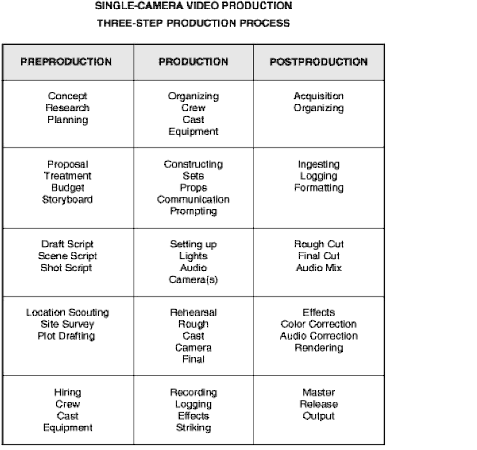
Develop your media program. We usually think of the stages involved in making media programs to comprise three phases, each with some parts, like this:
Normally, this model is followed more and more closely as the "stakes" get higher -- more money (such as coverage of the Olympics), greater cost of a screwup (such as a presidential funeral), or complexity (such as a World Series). Amateur productions, such as those found on YouTube, jump around -- as you would expect of an amateur.
Develop a client list of potential advertisers. Create a rate card. Create sales presentation materials (the things you would have in your hands if you were to make a sales call on a prime advertising prospect).
Create a website for the program. Make at least 5 pages of content. Figure out how you could sell web advertising; then create a rate card, a client list, and a sales presentation.
Devise a strategy for promoting your project. Such may include paid advertising (but you have to have the money in your budget!), stunts of various types, and so on. You'll find various "publicity and promotions" handbooks and guides in the library and on the web.
Organize your PROJECT into a clear, concise 10 - 15 page written document (1" margins, 12-point font). Put this in the first section of a binder. In a second section put your scripts, rate cards and other "mechanicals."
Separately, prepare to make a 15-minute team PITCH PRESENTATION of your project to an audience of potential investors. (It's called a "Pitch Meeting" in the business.) They will want to know how risky your plan is for their invested money. If you are clear in your plan, articulate in your presentation, and fully informed to answer questions, they'll be more inclined to support your enterprise. Plan to talk for 10 minutes and to take questions for 5 minutes. Be sure this presentation is well planned and well rehearsed. You must use PowerPoint. A sample of your program (a pilot) is required.
Your pilot should feature a well-told story without annoying mistakes or bling. There is no presumption that you have been schooled in production techniques or special effects, or that you have a big budget. Keep things simple. Expect to screen some of the pilot during your pitch presentation.
If your program will be audio (for radio), you may use one of the audio production studios in Bliss Hall. These systems feature ProTools editing software, which is a professional-level product. It might be prudent to do your editing on your own computer with a free program such as Audacity.
If your program will be video (for television), you may use one of the department's camcorders. YSU's video editing suites feature AVID Express -- again, a professional level product. You should do your basic editing on your own desktop with products such as PowerDirector or Adobe Premier.
Investors will give you money on the likelihood that you will make more money for them -- more money than they would make if they were to invest in the stock market, or a bank or another business. Normally, investors will ask these two questions: (1) is this the project that will make me a pile of money? and (2) are these the people who can pull it off?
Example: Look for "The Casey Malone Show" at noon on Sundays, WFMJ-TV. http://caseymaloneshow.com/ Also, look for "Kids Can Cook" on WFMJ-TV: http://www.wfmj.com/story/15583972/new-local-tv-show-kids-can-cook . See also, "The Best Startup Pitches of All Time ." See also, "Shark Tank " on ABC, Friday at 9PM.
Supplementary resource links are on my website. Some of your team members might not yet be competent team players -- they might not yet have learned how to work with others in such a setting. You might find the "Small Groups Checklist" to be helpful in helping them get with it.
Be Careful:
|
Teams sometimes self-destruct because two kinds of behavior are not controlled. First, be careful of the person who takes over and railroads the group. If the person's a certified genius, your team might come out okay. Chances are, he's not -- and you won't. Besides, you won't learn much if you're not an active part of decision-making. The second is the nodding doll. The person who sits quietly (often not coming to class or to team meetings), smiles a lot, and nods politely. He/she allows others to make all the decisions and to do all the work, only to show up at the last minute to claim credit for a job well done. You should make sure every individual is actively involved in the project, and you should monitor each person's progress. Keep strong leaders on a short lead; keep nodders on an even shorter one. Be particularly careful of "the Youngstown excuse." "I can't meet. I gotta work." "I can't meet. I gotta babysit." "I can't meet. I gotta study for an exam." The list of excuses is endless for people who don't want to make the group project a priority. Don't be sucked in by them. |
Communication will be among your biggest challenges. Exchange schedules, phone numbers, emails, and so on. Immediately set up a schedule for team meetings (no, not during class). Some people will claim that they can't meet at any time or at any place outside of class. Assume such claims are not valid, and they merely reflect a preference not to be inconvenienced. If your team encounters this problem, you may ask that a person be fired from the team, but only after you show that you have made a good faith attempt to include them.
Back Page: the final page of your 8-10 page document should be a specific summary of what each person did to help develop the project. Be sure to be specific and behaviorial ("wrote the script," "developed the Powerpoint slides," "created the client list and accompanying profiles"), not vague or general ("met with people," "edited the script," "coordinated the work of others"). Another way to think of this is to ask, what would we have seen this person doing? Or, what did this person accomplish?
Clearly, those who don't do much will not appear in this summary as having done much. Said differently, DO NOT allow others to take credit for your efforts on this project. (But eventually, when you have the title, the budget and the equity position, there'll be no limit to what you can do if you don't mind that other people take credit for it!)
This assignment asks you to engage in group-based problem solving. You'll be doing critical thinking as you analyze the problem, and you'll be doing creative thinking as you develop a solution. Don't gaze numbly off into space, waiting for someone to tell you what to do and how to do it. You've got to figure it out !!
And yes, I do understand that you might never have done something like this before.